
E302: Intentional Time Management for Midlife Wellness: How to Design Your Best Year Yet
Designing Your Best Year Yet: A Guide to Intentional Time Management for Midlife Wellness

We all have the same 8,760 hours in a year. Yet, if you are like most women in the middle of life, it often feels like those hours are slipping through your fingers like sand. Between managing a career, supporting aging parents, raising teenagers, and trying to maintain some semblance of a social life, your own health and well-being are often the first things to fall off the to-do list. This experience is widely supported by research. According to the American Psychological Association, women report higher levels of chronic stress during midlife, particularly when juggling caregiving and work responsibilities.
The reality is that for many of us, our time is spent "by default" rather than "by design". We lose hours to the "doom scroll" on social media or the mindless pull of the television, averaging over five hours a day combined, leaving us with a surprisingly small window for the things that truly light us up. But what if you could reclaim that time?
By shifting toward Intentional Time Management, you can move away from the hamster wheel of "chasing the next thing" and start building a life that feels energizing, purposeful, and sustainable.
Why Intentional Time Management is the Secret to Midlife Vitality
In midlife, our goals often shift from external achievements to internal well-being. We want to feel stronger, sleep better, and have more energy for the people we love. However, setting a goal like "I want to get fit" isn't enough. As James Clear, author of Atomic Habits, famously says, we don't rise to the level of our goals; we fall to the level of our systems. This concept is rooted in identity-based habit science, which James Clear explains in detail here.
Intentional Time Management is the process of building those systems. It’s about creating a structure that makes your healthy habits inevitable rather than optional.
The Power of Identity-Based Habits
One of the most effective ways to systemize your wellness is to start incredibly small, so small it’s almost impossible to fail. Consider the story of a man who wanted to become "someone who goes to the gym." His initial goal wasn't to work out for an hour; it was simply to drive to the gym, stay for five minutes, and go home.
While five minutes won't transform your physique, it does transform your identity. By showing up, he became a "person who goes to the gym". In midlife, where our schedules are often unpredictable, this "all-or-something" approach (rather than "all-or-nothing") is vital. Whether it’s five minutes on the Peloton or reading ten pages of a book, consistency builds the momentum that eventually leads to bigger changes.
"If it's not on your calendar, it's not real." — Jesse Itzler
Auditing Your Life: Moving from "Default" to "Design"
Before you can design a better year, you must understand where your time is currently going. An audit isn't about judgment; it’s about data. Start by asking yourself three pivotal questions:
What gave me energy last year?
What drained my energy?
What am I currently doing that I am "tolerating" but don’t actually want to do?
Identifying Energy Boosters vs. Energy Drains
We often spend time on things out of habit or obligation without realizing they are depleting us. For example, if scrolling through the news first thing in the morning leaves you feeling anxious and rushed, that is a significant energy drain. Conversely, a 15-minute walk in the morning sunlight might be the very thing that sets a positive tone for your entire day.
Reclaiming Your "Bookends"
Your morning and evening routines are the "bookends" of your day. They determine whether you start with focus or chaos, and whether you end with rest or exhaustion.
The Morning Routine: By simply avoiding your phone for the first 30 minutes of the day, you can reclaim lost time and mental clarity. We explore the power of digital boundaries more deeply in the podcast episode: Reclaim Your Peace: How to Live an Analog Life in a Digital World. One podcast host found that this single shift gave her 30 minutes of her morning back, allowing her to finish her workout earlier and feel more present.
The Evening Routine: Similarly, setting a "digital sunset" where you put your phone away at a specific time helps you transition into a restful state, ensuring you are set up for success the following morning.
Reframing Daily Obligations
Sometimes, the things that drain us are non-negotiable, like the daily carpool. However, Intentional Time Management also involves a mindset shift. Instead of viewing carpool as a chore, try reframing it as a "pocket of connection", a finite window of time to hear what’s happening in your child’s life or to connect with other parents in a "walking safety meeting" rather than at a bar.

Practical Steps to Systemize Your Wellness
Once you’ve audited your time, it’s time to build your anchors. These are the non-negotiables that keep you grounded, no matter how busy life gets.
1. Define Your Non-Negotiables
What are the 1–3 things that must happen for you to feel like yourself? For some, it’s moving their body every day. For others, it’s a specific sleep window or a meal-prepped lunch. These should be blocked out on your calendar just like a doctor's appointment. If you don't protect this time, someone else will fill it with their priorities.
2. Create Your Life "Buckets"
Think of your life in terms of "buckets" or focus areas:
Health: Movement, sleep, nutrition.
Relationships: Connection with family, friends, and partners.
Work/Finance: Career goals and financial health.
Adventure/Creativity: Things that bring you joy and excitement.
Organizing your goals into these buckets helps ensure you aren't over-indexing on one area (like work) while neglecting another (like health).
3. The Magic of Visual Planning
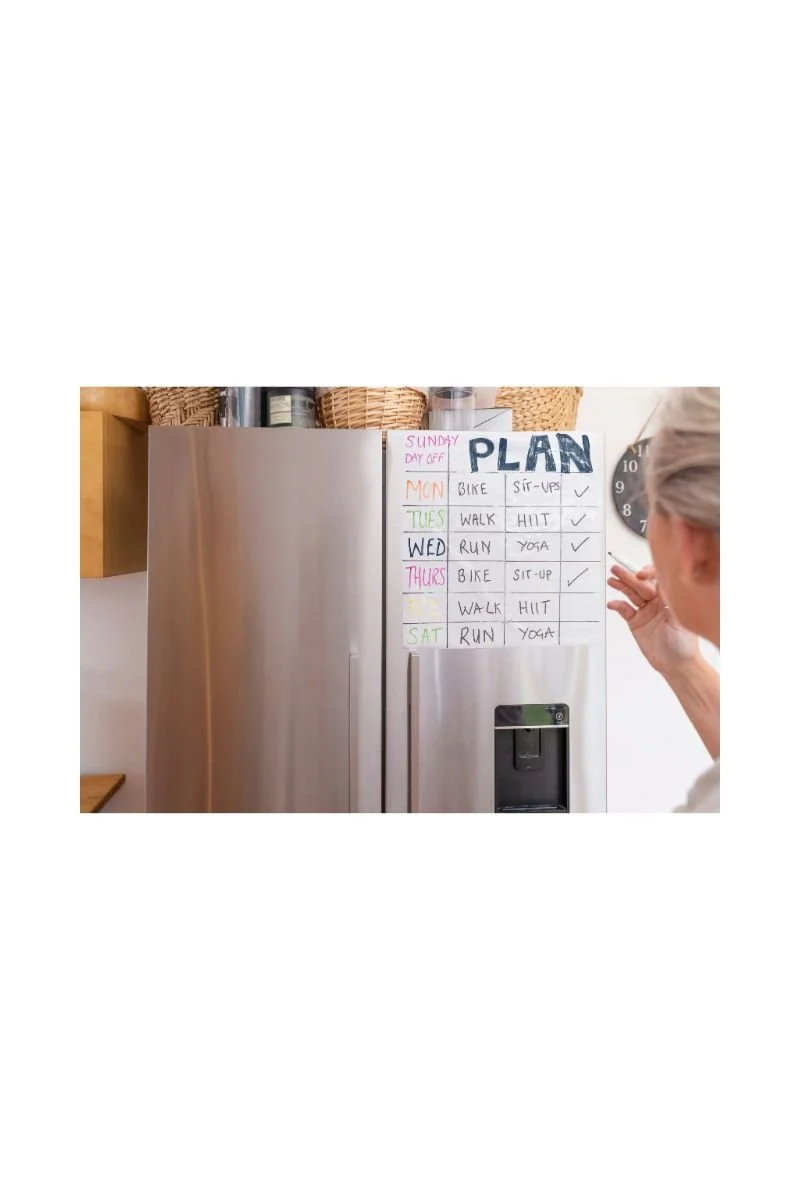
While digital calendars are great for meetings, there is a unique power in physical, visual planning. Using a large-format paper calendar lets you see your entire year or a six-month block at a glance.
Accountability: If you live with others, a visual calendar in a common area (like a mudroom) allows the whole family to see each other's goals and habits, fostering a sense of shared support.
Excitement: Seeing fun events, trips, or "anchors" on the horizon gives you something to look forward to, which is especially important during the long winter months.
Overcoming Obstacles: From All-or-Nothing to Intentional Progress
The biggest enemy of Intentional Time Management is the "all-or-nothing" mindset. We often think that if we can't do a 60-minute workout, there's no point in doing 10 minutes. But in midlife, "something" is always better than "nothing". If you’re navigating this shift, the episode: Stop the Midlife Spiral: How to Reset Your Energy offers practical guidance for creating sustainable momentum.
Silencing the Digital Noise
Interruptions are the primary thieves of productivity. Our phones ding, our emails ping, and our focus is constantly fractured. To get your most important work done, especially the "deep work" related to your own wellness, you must turn off notifications. Remember: you are not needed by everyone at every moment. Find your "peak performance" window (usually in the morning for many) and guard it fiercely.
Leveling Up with a "Misogi" Challenge
To keep things exciting, consider adding a "Misogi" challenge to your calendar. The concept of the Misogi challenge is rooted in an ancient Japanese Shinto ritual of purification. Traditionally, Misogi (禊) involved practitioners standing under the freezing waters of a sacred waterfall to wash away impurities and 'reset' the spirit. In a modern wellness context, it has been reimagined as a 'year-defining' event, a personal challenge so difficult that it clears away your mental clutter and proves exactly what you are capable of achieving. This is a year-defining challenge that pushes you outside your comfort zone. It doesn’t have to be expensive or athletic; it just has to be hard for you. It could be a 12-hour walk, a public speaking engagement, or a solo hiking trip. These challenges create lasting memories and prove to you that you are capable of more than you think.
"Nobody else is going to take as much interest in your life and what you want as you are. You are in charge of you."
Your Journey to Living by Design
As you look toward the months ahead, remember that you don't have to overhaul your entire life in a single day. Start with one small anchor. Perhaps it’s a 10-minute walk after dinner or a commitment to meal prep your lunches for the next three days.
The goal isn't perfection; it’s intention. By choosing to design your time, you are choosing to prioritize your vitality, your joy, and your future self.
What is one "anchor" habit you are committing to this week? Whether it’s reclaiming your morning or scheduling a 15-minute conversation with a loved one, we want to hear about it! Share your goals with us on social media or drop us an email. Let’s build a community of women living by design, not by default.