
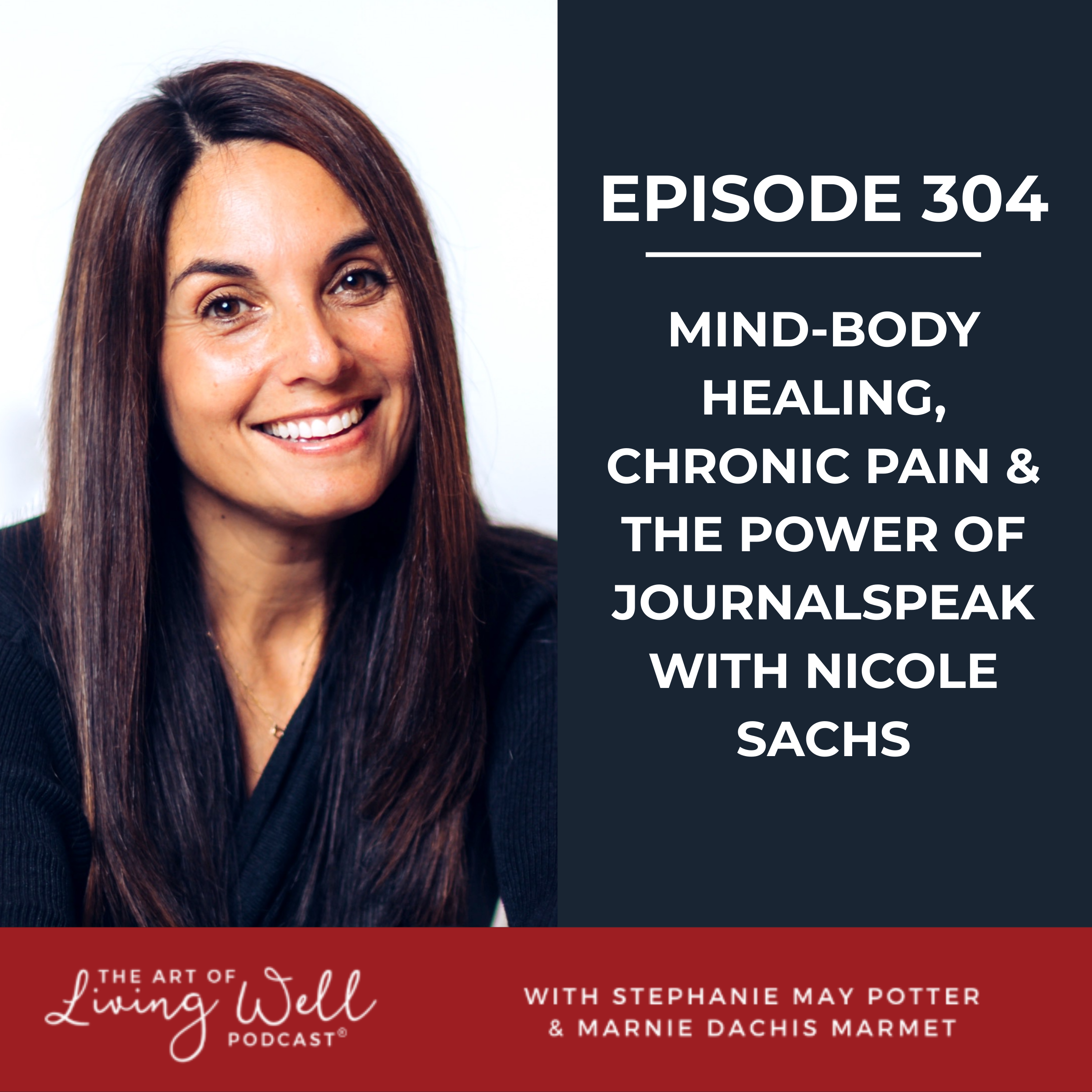
E304: The Power of Mind-Body Healing: Why Your Body hurts and How to Fix It
Beyond the Physical: Finding Freedom Through Mind-Body Healing
If you are a woman in midlife, you likely know the feeling of a "mysterious" ache. Perhaps it’s a nagging pain in your lower back that flared up after a stressful week at work. Maybe it’s a recurring migraine that strikes just as you’re trying to enjoy a quiet weekend. Or perhaps it’s a digestive issue that no elimination diet seems to fix.
For years, we’ve been told that these issues are purely structural, the result of "getting older," "hormonal shifts," or just bad luck. But what if the source of your physical suffering wasn't actually in your joints, your discs, or your gut? What if the key to your recovery was actually found in your nervous system?
In this episode, we sat down with Nicole Sachs, LCSW, a renowned speaker, author, and psychotherapist. Nicole has dedicated her life’s work to the practice of mind-body healing, helping thousands of people, particularly women, navigate their way out of chronic pain by addressing the emotional "static" that keeps their bodies in a state of high alert.
Understanding Mind-Body Healing: It’s Not "All in Your Head"
One of the biggest hurdles women face when exploring mind-body healing is the fear of being told their pain isn't "real." We’ve all been dismissed by a doctor at some point, told that our symptoms are just "stress" or "imaginary."
Nicole Sachs is the first to set the record straight: the pain is 100% physical. Whether it’s a muscle spasm, a nerve sensation, or an inflammatory response, the physical manifestation is happening. However, the trigger for that physical response is often not a structural injury, but a dysregulated nervous system.
The Science of Nervous System Dysregulation

Our brains have one primary job: to keep us alive. To do this, the brain is constantly scanning for danger. In our modern world, "danger" rarely looks like a saber-toothed tiger; instead, it looks like a looming deadline, a difficult conversation with a partner, or the overwhelming pressure of the "sandwich generation" (caring for both children and aging parents).
When we experience emotions that our brain deems "dangerous", such as intense rage, deep shame, or paralyzing terror, the brain looks for a way to protect us. It creates a distraction. By sending a signal to tighten muscles or restrict blood flow to a specific area (like the back or the head), the brain shifts our focus from an "unacceptable" emotion to a physical sensation. This is the essence of mind-body healing: recognizing that the body is using pain as a shield.
The "Reservoir" Analogy
Nicole describes every human being as having an "emotional reservoir." From the time we are children, we begin filling this reservoir with feelings we aren't allowed to express. For women in midlife, this reservoir is often near the brim. We’ve spent decades being the "good girl," the reliable employee, and the selfless mother.
We’ve pushed down our anger, our grief, and our despair because society tells us those feelings are "unfeminine" or "weak." But as Nicole points out, those emotions don't just disappear; they sit in the reservoir, creating pressure. When the reservoir overflows, the nervous system enters a state of chronic "fight or flight," and physical pain becomes the body's primary language.
Why Midlife is the Peak for Chronic Pain
Midlife is a unique intersection of physical change and intense emotional responsibility. As we navigate perimenopause and menopause, our bodies are already in a state of flux. Add to that the emotional weight of midlife, questioning our purpose, dealing with "empty nest" syndrome, or managing the health of our parents, and it’s no wonder our reservoirs are overflowing.
"If women have rage, they’re shrill, they’re unfeminine... Nobody is allowed to feel the big ones. And so your brain knows that." — Nicole Sachs
Nicole explains that the brain perceives our "unacceptable" emotions as a threat to our social standing or our safety. If we were to actually feel the true depth of our rage or grief, the brain fears we might lose our relationships or our stability. To "save" us, it gives us a backache instead.
The Solution: How to Practice "JournalSpeak"

If the problem is a full reservoir and a panicked nervous system, the solution is to provide a safe outlet for those emotions. This is where Nicole’s signature practice, JournalSpeak, comes in. This isn't your typical "Dear Diary" gratitude journaling. It is a raw, unfiltered, and often "ugly" process designed for chronic pain relief.
The Three Legs of the Stool
Before diving into the practice, Nicole emphasizes that mind-body healing requires a foundation. She calls this the "three legs of the stool":
Belief (Education): You must understand the science. You need to know why your brain is doing this so that when the pain flares up, you can meet it with logic rather than fear.
Doing the Work: This is the JournalSpeak practice itself. It’s the daily commitment to sitting with your "shadow" self.
Self-Compassion: You cannot heal a body you hate. You must move from being your own harshest critic to being your own fiercest advocate.
A Simple Daily Ritual: The 20/10 Rule
The JournalSpeak practice is broken down into two distinct phases to ensure nervous system regulation:
The 20-Minute Rant: Set a timer for 20 minutes. Pick a topic, a person, a situation, or a memory, and write (or type) without any filter. This is your chance to be "immature, irrational, and mean." Say the things you would never say out loud. "I hate my boss," "I'm resentful of my kids," "I feel like a failure." You aren't saying these are your permanent truths; you are simply emptying the sludge from the reservoir.
The Immediate Destruction: Once the timer goes off, destroy what you wrote. Rip up the paper or delete the document. This is a crucial signal to your brain: The "dangerous" thoughts have been expressed, they are gone, and you are safe.
The 10-Minute Meditation: Spend the final 10 minutes in silence, listening to a guided meditation or simply focusing on your breath. This transitions your body from the "stress" of the journaling back into a state of "rest and repair."
Embracing the Art of Living Well in Midlife

We asked Nicole what "living well" means to her. Her answer was perfectly suited for the midlife journey.
Nicole suggests that living well isn't about being "perfectly happy" or "pain-free" every second of the day. It’s about clearing the "static." When our reservoirs are full, and our bodies are screaming in pain, we see our lives through a distorted lens. We might look at our partner and only see their flaws, or look at our career and only feel exhaustion.
"The art of living well is to live in alignment with myself and my decisions. And I do that by clearing away the static." — Nicole Sachs.
By engaging in mind-body healing, we clear that static. We begin to see our lives and ourselves with more clarity. We realize that we have choices. As Nicole puts it, life is often a choice between "what hurts and what hurts worse." Facing our repressed emotions hurts for 20 minutes a day, but living a life limited by chronic physical pain hurts much worse in the long run.
Moving Toward Emotional Wellness
The journey of mind-body healing is a marathon, not a sprint. It requires us to look at the parts of ourselves we’ve spent years hiding. But for the woman who has tried every physical therapy, every pill, and every surgery only to remain in pain, this work offers something the traditional medical system often can't: hope.
When we regulate our nervous system, we aren't just "fixing" a backache. We are reclaiming our vitality. We are telling our bodies that it is safe to be human, safe to be angry, and safe to be whole.
Your Next Step Toward Healing
If this resonates with you, you don't have to have all the answers today. You don't even have to be 100% convinced that it will work. All you need is a little bit of curiosity.
Would you like to start your own healing journey?
Listen: Find Nicole Sachs’ podcast, The Cure for Chronic Pain, for more deep dives into these topics.
Read: Pick up her book, The Meaning of Truth, to understand the stories we tell ourselves.
Practice: Set a timer today for just 10 minutes and try your first JournalSpeak "rant." See what your body has been waiting to say.
You’ve spent your life taking care of everyone else. Isn't it time you listened to the one person who has been trying to get your attention all along? Your body is ready to heal; it’s just waiting for you to hear the message.