
E321: Beyond Brain Fog and Hot Flashes: Why Menopause Can Be Your Most Empowering Era
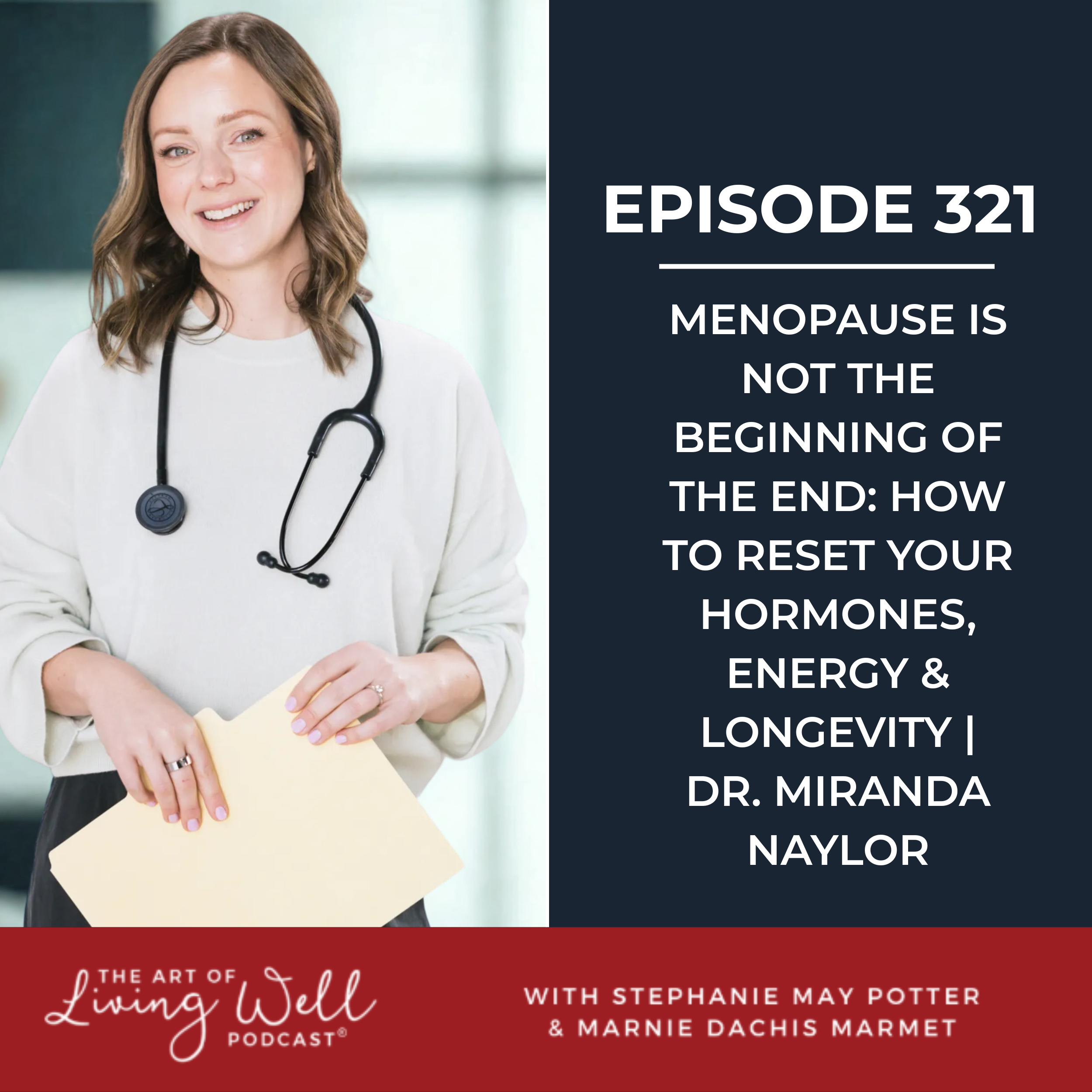
What if everything you’ve been told about menopause is completely wrong? What if the sudden weight gain, the impenetrable brain fog, the low energy, and that lingering feeling of falling apart aren't simply your destiny just because you're getting a little older?
On our most recent episode of The Art of Living Well Podcast®, we sat down with Dr. Miranda Naylor, a physician, hormone expert, and host of the Modern Women’s Wellness Podcast. We completely reframed the cultural conversation around aging, offering a powerful, hopeful approach to holistic menopause management.
If you’ve ever found yourself sighing and thinking, “Well, this is just what happens to women at my age,” this conversation is for you. Menopause doesn’t have to be a story of decline, instead, it can be an incredible opportunity to reset your health, energy, and longevity.
Debunking the Menopause Myths
We live in a society that frequently frames aging, particularly for women, as a tragic loss of vitality. But Dr. Naylor is challenging that narrative head on.
Myth 1: Hormones Are Set in Stone One of the biggest misconceptions women hold early on is that hormones are static and unchangeable. Dr. Naylor explains that hormones are actually intricate signalers within the body, constantly interacting with one another and highly responsive to our cellular health and overall wellness. This means that the story of our hormones is beautifully complex, and we hold so much more power over how they function than we’ve been led to believe.
Myth 2: Menopause is Just About Decline The traditional societal narrative tells us that menopause is the beginning of the end. We heavily prize youth and vitality, leaving little room or language for the menopausal transition. Dr. Naylor points out a stark double standard: when a woman is pregnant, we normalize her bodily changes, like needing to eat more or use the restroom more often. But when a woman goes through menopause and has to leave a room because she's sweating or experiencing changes, society implies that something is ‘wrong’ with her. In reality, menopause can usher in incredible wisdom, beauty, and purpose. Pop culture is finally catching up to this, too; as Marnie notes, shows like Friends and Neighbors are finally depicting menopausal symptoms on screen, removing the taboo that existed when our mothers were going through it.
Myth 3: Your Mother's Menopause is Your Destiny Many women assume that because their mothers suffered through terrible hot flashes and mood swings, they are doomed to the exact same fate. This simply isn't true. Dr. Naylor notes that genetics only play about a 50% role in when we go through menopause. The rest is heavily dependent on environment and lifestyle factors, meaning you have an immense amount of control over your own experience.
The "I Don't Care" Phase: Finding Freedom in Menopause
While we often focus heavily on physical symptoms, there is a great emotional and psychological shift that happens during perimenopause and menopause.
"You don't care what people think anymore... there can be so much beauty and wisdom that comes out of the menopausal time period." – Dr. Miranda Naylor
Women spend decades caring deeply about what others think, striving for perfection, and people pleasing. But as hormones shift, and potentially as estrogen declines, many women find themselves experiencing a glorious liberation. As Dr. Naylor, who recently entered her 40s, experienced herself, dropping the tether that keeps us trying to be a certain way is absolutely freeing.
This liberation can sometimes manifest in surprising ways, such as a sudden feeling of rage. Marnie notes that alongside the freedom of aging comes occasional bursts of anger. Dr. Naylor suggests this might be deeply connected to the fact that women are traditionally not allowed to express anger, storing it up in their bodies for years. Menopause might just be the moment the dam breaks, and women finally say, "I'm done holding this in."
Ultimately, this phase shouldn't be about trying to claw your way back to how your body functioned in your 20s. As Stephanie pointed out, it’s a catalyst for hope and a healthy reset. It is a time to ask yourself: What does my body need now?
Taking Control: Holistic Menopause Management, HRT, and Beyond

As estrogen and progesterone decline, certain health risks naturally rise, such as cardiovascular disease, bone density loss (osteoporosis), and cognitive decline. Almost every tissue in a woman's body has receptors for estrogen, including the brain, bones, muscles, and skin.
The Role of Hormone Replacement Therapy (HRT) While sometimes viewed as a polarized topic, hormone replacement therapy, often using bioidentical hormones, is a remarkably safe and beneficial tool for many women to take back control of their transition.
Progesterone: Dr. Naylor typically introduces cyclical progesterone during perimenopause (taking it in the luteal phase after ovulation) to alleviate heavy periods, PMS, anxiety, and moodiness.
Estrogen: Later, as estrogen levels drop or become erratic, often signaled by vasomotor symptoms like hot flashes and night sweats, she may introduce estradiol. Patches or creams (transdermal) are highly preferred over oral pills, as they come with fewer risks and are better tolerated by the body.
Testosterone & DHEA: Testosterone cream might also be utilized if a woman struggles with low libido, low motivation, or muscle loss, often starting with DHEA supplementation first.
The Importance of Testing Even if you are not experiencing severe symptoms, Dr. Naylor heavily advocates for regular hormone testing, ideally checking a full panel yearly, often around day three of your cycle. Conventional medicine often waits for a disease to be present before offering treatment, questioning why you would treat something if there are no symptoms. But functional and integrative medicine focuses on optimization and longevity. Knowing your baseline helps you and your provider make informed decisions about whether HRT could act as a supportive, preventative tool against future health insults, especially if you have a family history of heart disease or osteoporosis.
The Unsexy (But Crucial) Foundation of Menopause Health
While supplements and HRT are fantastic tools, they cannot replace the foundational pillars of health. As Dr. Naylor affectionately calls them, these habits are boring, mundane, and not sexy, but they are the true drivers of holistic menopause management. Women often jump straight to wanting a quick pill, but skipping these lifestyle steps is a disservice to your body.
Nutrition and Hydration It sounds basic, but many women simply aren't eating enough food to support their changing bodies. A protective diet focuses on a wide variety of colorful plants, spices, and herbs, along with adequate protein to maintain muscle mass. Deep hydration is equally necessary so the body's essential functions can operate smoothly. As Marnie observed during a recent trip to Croatia, a true Mediterranean lifestyle, where food is naturally organic, fresh from the garden or ocean, and minimally processed, makes a massive difference in overall health.

Stress Relief and Sleep Women are constantly redlining, pushing, going, and doing for everyone else. Lowering stress isn't just a nice idea, it's a physiological necessity. We need non-sleep deep rest, and we need to actively take things off our plates. Speaking of rest, getting high-quality restorative sleep is absolutely critical. Sleep is when our bodies produce hormones and repair tissues. Skipping sleep to binge-watch Netflix actively works against your menopausal transition.
The Power of Community and Joy This is perhaps the most overlooked aspect of wellness. Dr. Naylor emphasizes that finding joy, experiencing awe, and leaning into a community are incredibly powerful. She cited a fascinating study of a tight-knit Italian community in which, despite smoking and drinking, residents had remarkably low disease risk, attributable solely to their strong social bonds. Once that community dissolved and people moved away, cardiovascular risks skyrocketed. For midlife women, having a supportive circle of friends on a similar path makes the hard days easier to navigate.
Joyful Movement Exercise shouldn't be a punishment. The goal is to avoid being sedentary and move your body in ways that genuinely feel fun to you. Additionally, working your muscles is important to protect against bone and muscle loss as you age.
Embracing Your Next Chapter
Menopause is not a disease; it is a hormonal transition, much like the shift from pregnancy to postpartum. It requires us to come back to ourselves in a new way, discovering what brings us vitality in this current season of life. By shifting our mindset, exploring medical tools like bioidentical hormones, and doubling down on our foundational health, we can make these years some of the most vibrant and liberated of our lives.
"It is an incredible opportunity to just throw out what isn't working anymore and then find these new tools." – Dr. Miranda Naylor
Take a moment today to assess your foundational habits. Are you prioritizing restorative sleep? Are you nourishing your body? Do you have a supportive community lifting you? Share this post with a friend who might need a reminder that their best, most vibrant years are still ahead! And if you want to dive even deeper into this empowering conversation, be sure to listen to the full episode with Dr. Miranda Naylor on The Art of Living Well Podcast®.